Door Handle Spindles: Sizes, Types and How to Replace One
A door handle spindle is the square steel bar that runs through the door and connects the handle on each side to the latch. Turn the handle, the spindle turns the latch, the door opens. In the UK the standard size for lever handles and knobs is 8mm square; bathroom turn-and-release fittings usually take 5mm. Length depends on your door thickness — most internal doors need 90–110mm.
In a hurry?
If you are replacing a spindle that snapped or went missing, measure your door thickness, add the depth of both roses or backplates, then add about 10mm so there is enough bar to engage both handles. Round up to the nearest stock length. Shop door handle spindles ›
What is a door handle spindle?

A spindle is a rod — almost always square in section — that connects the two door handles on either side of a door so that the latch retracts when either handle is turned. Without it, the handle spins freely and the door will not open.
Spindles are sold in a range of lengths and a small number of standard thicknesses. Getting both right is the whole job: too short and the bar will not reach both handles, too long and it fouls the rose or stands proud of the handle.
What size spindle do I need?
There are two measurements that matter — the thickness of the bar, and its length.
Spindle thickness
| Size | Where you will find it |
|---|---|
| 8mm square | The UK standard. Lever handles, mortice knobs and most internal door furniture. |
| 5mm square | Bathroom turn-and-release sets and thumbturns. |
| 7mm square | Some uPVC, composite and continental multipoint hardware. Check before you order. |
If you are unsure, measure across the flat faces of the old bar with a vernier or a steel rule. An 8mm bar will not fit a 7mm handle and vice versa, so this is worth confirming rather than guessing.
Spindle length
Length is driven by how thick the door is and how deep the handles sit on it. As a starting point:
| Door thickness | Typical spindle length |
|---|---|
| 35mm — standard internal door | 90–100mm |
| 40–44mm — FD30 fire door | 100–110mm |
| 45–54mm | 110–120mm |
| 55mm+, uPVC and composite | 120–160mm |
These are guides, not guarantees — handles on a deep backplate or a chunky rose need more bar than a slim concealed-fix rose on the same door. The reliable method is: door thickness + depth of both roses + roughly 10mm, then round up to the nearest available length. A spindle that is slightly long can usually be cut down with a hacksaw; one that is too short is scrap.
Types of door handle spindle
- Solid spindles — one continuous bar. Both handles move together. This is what most internal doors use.
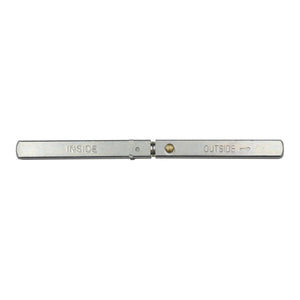
- Split spindles — two half-bars that operate independently, so one side can be locked or held while the other still works. Used on bathroom privacy sets and on doors where the outside handle must stay fixed.
- Adjustable and extended spindles — longer bars, sometimes with a screw adjustment, for thick doors, uPVC and composite doors, or where a standard length falls short.
When do you need a split spindle?
A split spindle is required whenever the two sides of the door must behave differently. The two common cases are:
- Bathroom and WC doors with a lever on the inside and a fixed knob or emergency release outside.
- Front and escape doors with a multipoint lock, where the outside handle should not retract the latch when the door is locked.
If you fit a solid spindle where a split one is needed, both handles will operate the latch and the privacy or security function is lost. Check what came out of the door before ordering.
What are spindles made from?
- Steel — the usual choice. Strong, cheap, right for high-traffic doors. Bare steel can rust in damp conditions, so zinc-plated is preferable for bathrooms and exterior doors.
- Brass — corrosion resistant and used on more decorative hardware, though softer than steel.
- Zinc alloy — a middle ground on strength and corrosion resistance, common on mid-range hardware.
How to measure your existing spindle
- Take the handle off. Undo the grub screw or the rose fixings and pull the handle away from the door to expose the bar.
- Measure the length end to end with a steel rule. On an adjustable spindle, measure it at its shortest setting.
- Measure the thickness across the flats — 5mm, 7mm or 8mm.
- Check the profile. Note whether it is a plain square bar, a split pair, or has machined or threaded ends.
How to replace a door handle spindle
You will need a screwdriver, the replacement spindle and, ideally, a tape measure.
- Remove the handles. Undo the grub screws or rose fixings on both sides and lift the handles clear.
- Slide out the old spindle. It should pull straight through the latch. If it is seized, tap it out gently from one side with a punch or a screwdriver shaft — do not lever against the latch case.
- Fit the new bar. Push it through the latch so an equal amount protrudes on each side. On a split spindle, the longer half normally goes on the lever side.
- Refit the handles and tighten the grub screws onto the flats of the bar, not the corners. Test the latch several times with the door open before closing it.
Common spindle problems and how to fix them
The handle is loose or droops
Usually the grub screw has backed off, or the spindle has worn round at the point where the screw bites. Tighten the grub screw first. If the handle still moves independently of the bar, the spindle is worn and needs replacing.
The handle turns but the latch does not move
The spindle has either snapped inside the latch or is too short to engage both handles. Take a handle off and check whether the bar reaches through.
The spindle is stuck and will not come out
Rust or paint in the latch follower is the usual cause. Work a little penetrating lubricant into the follower, leave it, then tap the bar through from the opposite side. Never force it with pliers — you will burr the end and make it worse.
The spindle sticks or feels gritty
Dirt or corrosion in the mechanism. Clean the bar and put a light lubricant on the follower.
Looking after your spindles
- Check the grub screws once or twice a year — a loose screw is what wears a spindle round.
- Lubricate the latch follower occasionally so the bar turns freely.
- Use plated or brass bars on bathroom and exterior doors to keep rust out.
- Keep the bar centred so it engages both handles evenly.
Frequently asked questions
What is a spindle on a door handle?
It is the square bar that passes through the door and links both handles to the latch. Turning either handle turns the bar, which retracts the latch and opens the door.
Are door handle spindles a standard size?
The thickness is close to standard — 8mm square covers the great majority of UK lever handles and knobs, with 5mm used for bathroom turn-and-release. Length is not standard: it depends on your door thickness and how deep the handles sit, which is why spindles are sold in a range of lengths from around 90mm upwards.
What size spindle do I need for my door?
Add your door thickness to the depth of both roses or backplates, then add about 10mm, and round up to the nearest stock length. A 35mm internal door with slim roses typically needs 90–100mm.
What is a split spindle door handle?
A split spindle is a two-piece bar that lets each handle operate independently. It is used on bathroom privacy sets and on locked exterior doors, where the outside handle must not retract the latch.
How do I fix a spindle on a door handle?
If the handle is loose, tighten the grub screw. If the handle turns without moving the latch, the bar has snapped or is too short — remove a handle, pull the old bar out and fit a correctly sized replacement.
How do I remove a spindle from a door handle?
Undo the grub screw or rose fixings, pull the handle off, then slide the bar out through the latch. If it is seized, apply penetrating lubricant and tap it through from the other side.
Do door handles come with spindles?
Most complete handle sets include a spindle of standard length. Spare and replacement bars are sold separately, which is what you need if yours has snapped or you are fitting a thicker door.
Can I cut a spindle down?
Yes. A plain steel bar can be shortened with a hacksaw and the cut end filed smooth. Do not do this with split or threaded spindles, where the ends are machined for a purpose.
Where can I find replacement door handle spindles?
We stock square, split and extended spindles in the common UK sizes — browse the full range here. If you are unsure which you need, send us a photo and a measurement and we will tell you.
For more advice on choosing door hardware, read our complete guide to door handles — covering types, finishes, backplates and buying tips for every room.
Shop door handle spindles
Square, split and extended spindles in 5mm and 8mm — from £1.99.